Domain Model & Terminology
The domain model, entity relationships, and lifecycle states.
Domain Model & Terminology
The platform uses a clear, consistent domain model. Each term maps to a distinct architectural concept.
Glossary
| Term | Meaning |
|---|---|
| Console | Web platform (control plane) |
| alethia | CLI tool |
| Zone | Workspace / project grouping |
| Spec | A single infrastructure configuration |
| Runner | Execution agent (worker) |
| Apply | Deployment action (alethia apply) |
| Design | Create a new Spec configuration |
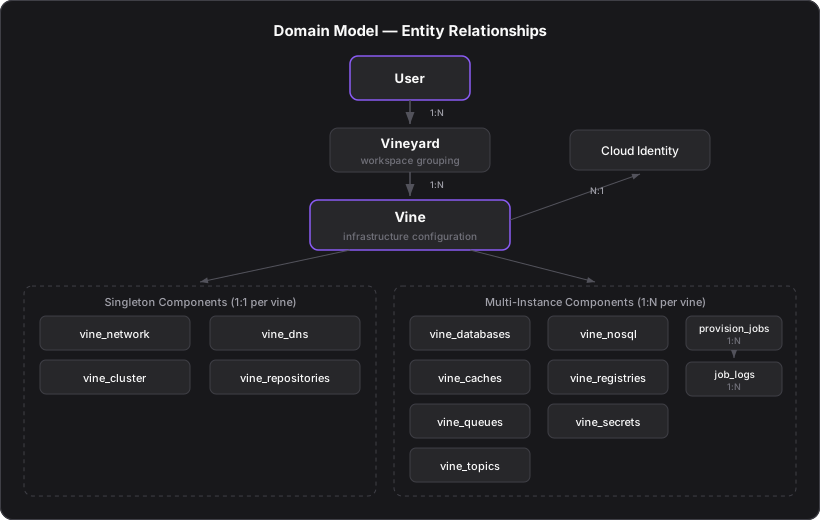
Entity Relationships
User
 └── Zones (1:N)
      └── Specs (1:N)
           ├── Cloud Identity (N:1) ─── links to AWS/GCP/Azure account
           ├── spec_network (1:1) ─── VPC / VNet / VPC Network
           ├── spec_cluster (1:1) ─── EKS / GKE / AKS
           ├── spec_dns (1:1) ─── Route53 / Cloud DNS / Azure DNS
           ├── spec_repositories (1:1) ─── Git repo references
           ├── spec_databases (1:N) ─── Aurora / Cloud SQL / Azure DB
           ├── spec_caches (1:N) ─── ElastiCache / Memorystore / Azure Cache
           ├── spec_queues (1:N) ─── SQS / Pub/Sub / Service Bus
           ├── spec_topics (1:N) ─── SNS / Pub/Sub / Service Bus Topics
           ├── spec_nosql_tables (1:N) ─── DynamoDB / Firestore / Cosmos DB
           ├── spec_container_registries (1:N) ─── ECR / Artifact Registry / ACR
           ├── spec_secrets (1:N) ─── Secrets Manager / Secret Manager / Key Vault
           └── provision_jobs (1:N) ─── PLAN, DEPLOY, DESTROY, etc.
                └── provision_job_logs (1:N)
A Zone contains one or more Specs, and a Spec is provisioned by a Runner.
Singleton components (1:1 per Spec): network, cluster, DNS, repositories. Every Spec has exactly one of each (or none if that section is disabled).
Multi-instance components (1:N per Spec): databases, caches, queues, topics, NoSQL tables, container registries, secrets. A Spec can have zero or many of each.
Spec Lifecycle
A Spec progresses through these states:
DRAFT ──► QUEUED ──► PROVISIONING ──► ACTIVE
                                        │
                                        ▼
                                    DESTROYING ──► DESTROYED
                                        │
                                        ▼
FAILED| Status | Meaning |
|---|---|
DRAFT | Configuration created but not yet submitted for provisioning |
QUEUED | A provisioning job has been created and is waiting for a Runner |
PROVISIONING | A Runner is actively running Terraform |
ACTIVE | Infrastructure is provisioned and running |
DESTROYING | A destroy job is in progress |
DESTROYED | Infrastructure has been torn down |
FAILED | Provisioning or destruction failed (can be retried) |
Component Status
Each Spec component (network, cluster, database, etc.) has its own status independent of the parent Spec:
| Status | Meaning |
|---|---|
PENDING | Awaiting first provisioning |
CREATING | Currently being created by Terraform |
ACTIVE | Successfully provisioned |
UPDATING | Configuration change being applied |
FAILED | Creation or update failed |
DESTROYING | Being torn down |
DESTROYED | Successfully removed |
Job Lifecycle
Jobs represent units of work executed by Runners:
QUEUED ──► CLAIMED ──► PROCESSING ──► SUCCESS
                          │
                          ├──► FAILED
                          │
└──► CANCELLED| Status | Meaning |
|---|---|
QUEUED | Waiting in the queue for a Runner to claim |
CLAIMED | A Runner has atomically claimed this job |
PROCESSING | Runner is actively executing (Terraform running) |
SUCCESS | Job completed successfully |
FAILED | Job failed (error message attached) |
CANCELLED | User cancelled the job before completion |
Job Types
| Type | Purpose |
|---|---|
CONNECTION_TEST | Verify cloud credentials work, cache discovered resources |
FETCH_RESOURCES | Discover existing cloud resources (VPCs, subnets, hosted zones) |
BOOTSTRAP | Initialize infrastructure workspace |
PLAN | Run terraform plan + optional Infracost analysis |
DEPLOY | Run terraform apply + install ArgoCD |
DESTROY | Run terraform destroy with graceful cleanup |
DEPLOY_WORKER | Provision Runner infrastructure (ECS task definition, IAM roles) |
DESTROY_WORKER | Tear down Runner infrastructure |
Environment Stages
Each Spec targets a specific environment:
| Stage | Purpose |
|---|---|
development | Development/testing infrastructure |
staging | Pre-production validation |
production | Production workloads |
The environment stage affects naming conventions, resource sizing defaults, and Terraform state paths.